

The highest standard we set, held to the letter
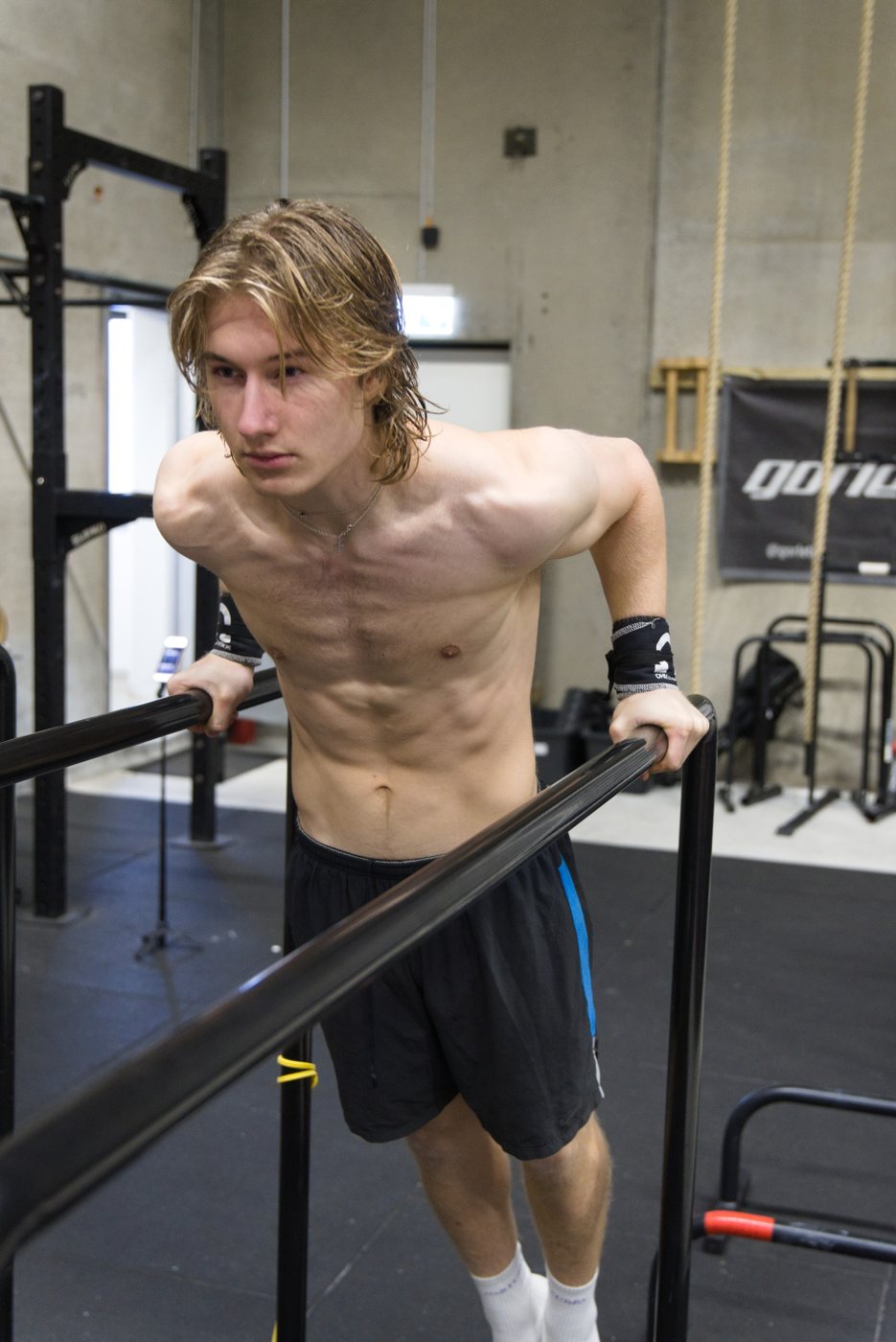
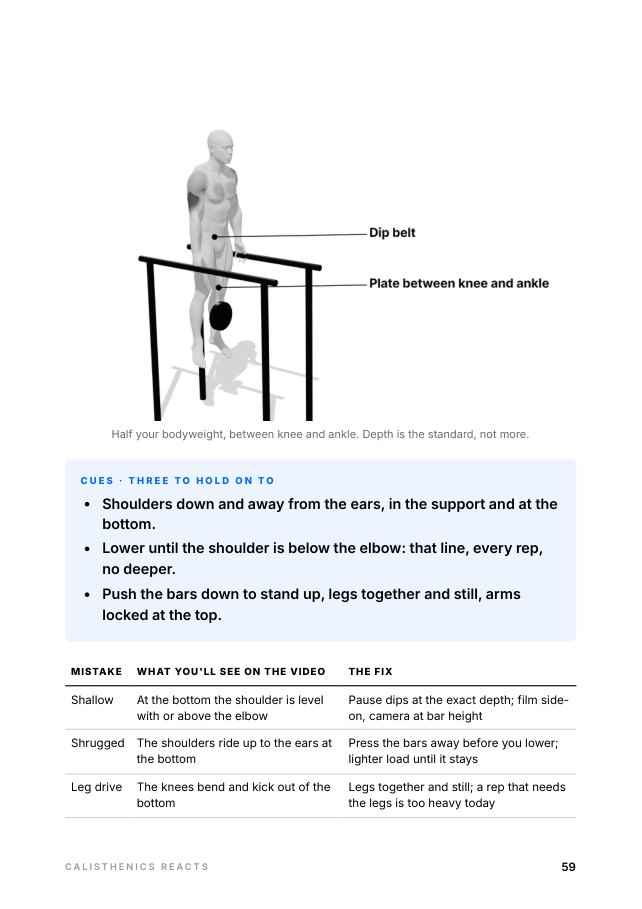
The highest standard we set. An ISF-ranked weighted pull-up, half your bodyweight on a dip, ten muscle-ups, navel-height pulls and The 280 in a vest.
Secure checkout by Stripe
Refund if it isn't what you expected · every future edition, free · no discounts, ever
New edition, 1 November 2026. Start here, a plan for any week, a swap for every exercise, cue boxes and Ole's photos throughout. Buyers of earlier editions get it free.
Plan your week with this guide, free2 to 7 days, 1 to 3 trainings a day, a swap for every exercise. See it before you buy.For the advanced athlete who wants every domain at the top of the scale.
Not for anyone under eighteen chasing adult loads: the youth Elite is bodyweight, on purpose.

What's inside
Every domain at this level, tested on video, with every number labelled: official rule, external benchmark, our standard or evidence gap. Your level is your lowest domain.
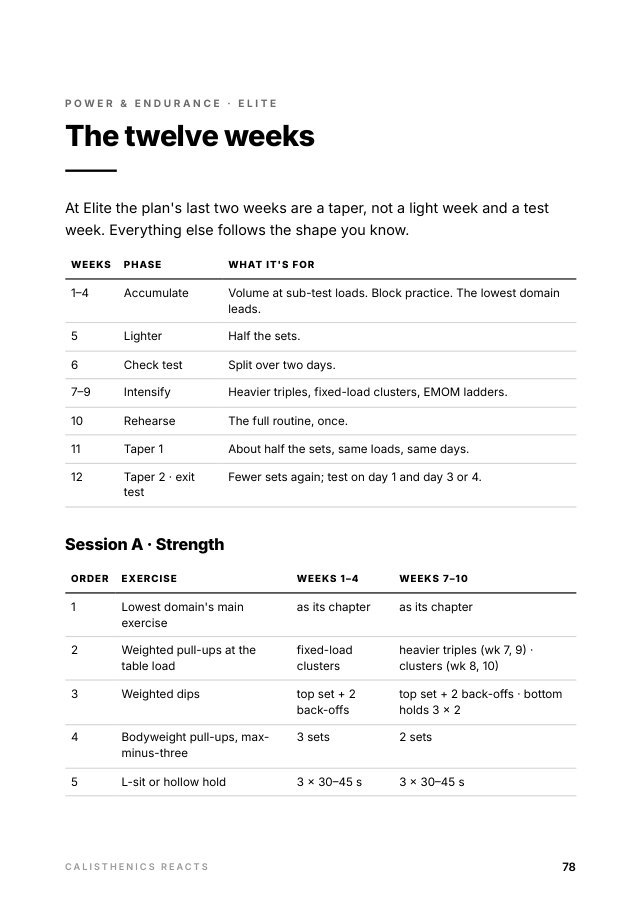
Twelve weeks, laid out for any week: two to seven days, one to three trainings a day, with a swap for every exercise. A check test at week six, the exit test at week twelve, and a ladder for every movement with the rule that decides when you climb.
Three scorecards and a 36-session log to write in, so every rep you count is one you can show.
Safety gates where the risk is, a pain rule for when to stop and see someone, and a chapter on training under eighteen. No youth label needs an adult load.
Every chapter is graded: strong, promising, contested or coaching practice. The research behind each graded chapter is at the back, with where it comes from.
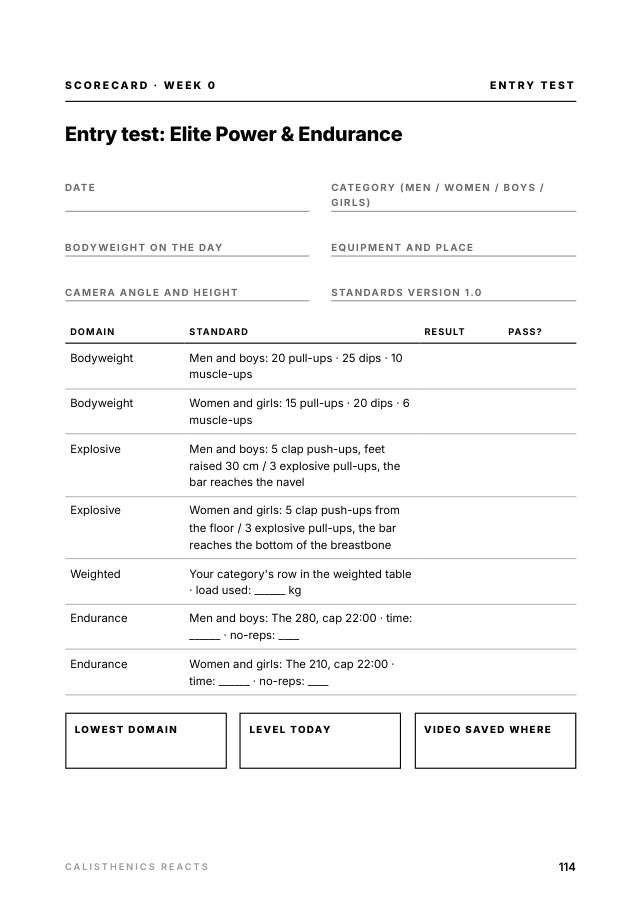
What you have to show, on video, to pass. Your level is your lowest domain. Every number below is ours unless the guide names a rule or a table, and every one is printed in the guide with its label.
| Bodyweight | Men and boys: 20 pull-ups · 25 dips · 10 muscle-ups Women and girls: 15 pull-ups · 20 dips · 6 muscle-ups |
|---|---|
| Explosive | Men and boys: 5 clap push-ups, feet raised 30 cm / 3 explosive pull-ups, the bar reaches the navel Women and girls: 5 clap push-ups from the floor / 3 explosive pull-ups, the bar reaches the bottom of the breastbone |
| Weighted | Open men (18+): pull-up ISF +32 kg, open men table: Rank 3 at your bodyweight · dip +50% bodyweight × 5 Open women (18+): pull-up ISF +12 kg, open women table: Rank 3 at your bodyweight · dip +30% bodyweight × 5 Youth boys (13–17): pull-up ISF +8 kg, boys 13–17 table: Youth 1 at your bodyweight · dip +15% bodyweight × 5 Youth girls (13–17): pull-up ISF +8 kg, girls 13–17 table: Youth 1 at your bodyweight · dip +10% bodyweight × 5 |
| Endurance | Men and boys: The 280, under 22:00 Women and girls: The 210, under 22:00 |
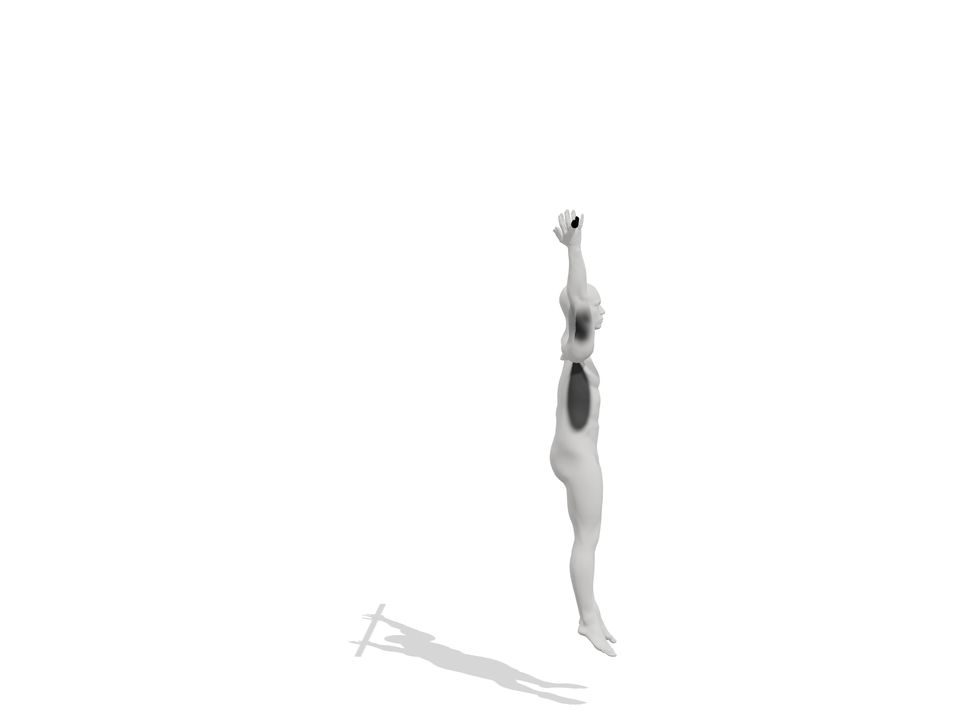
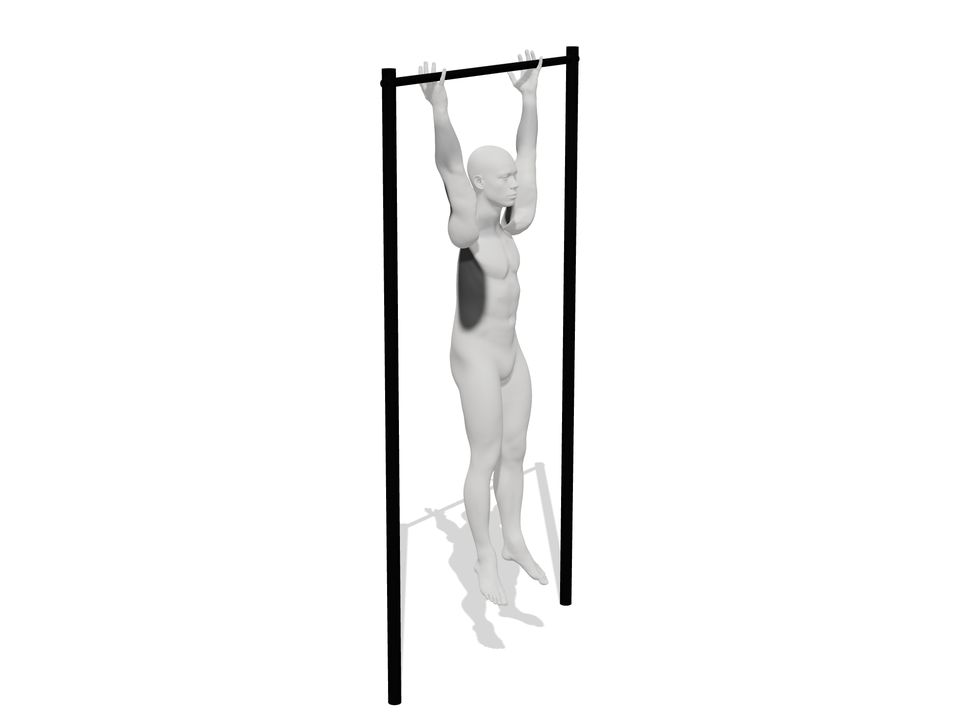
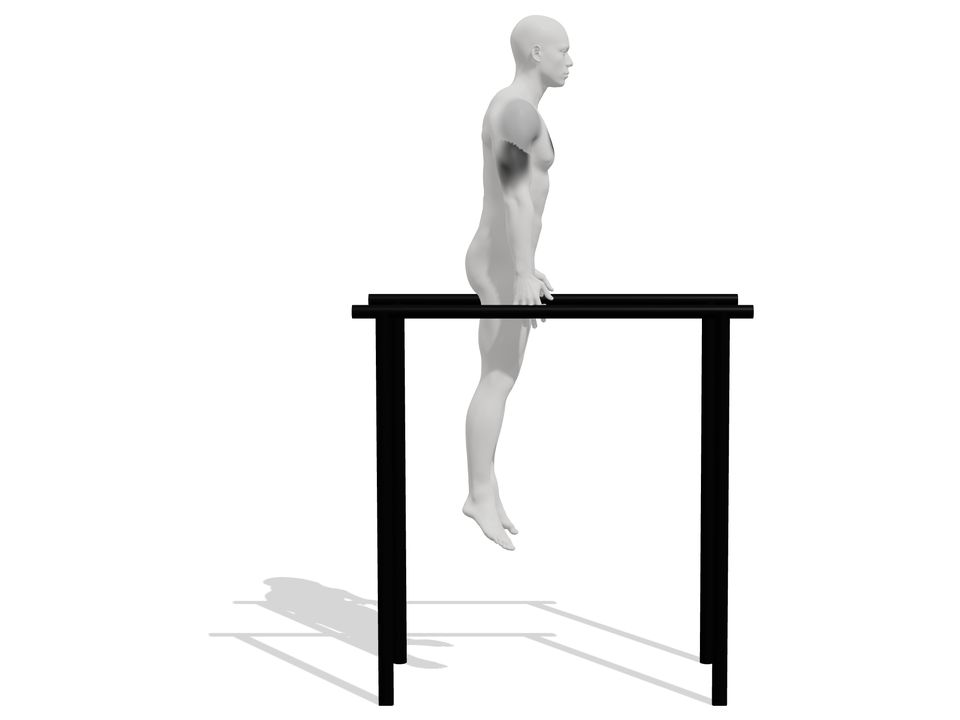
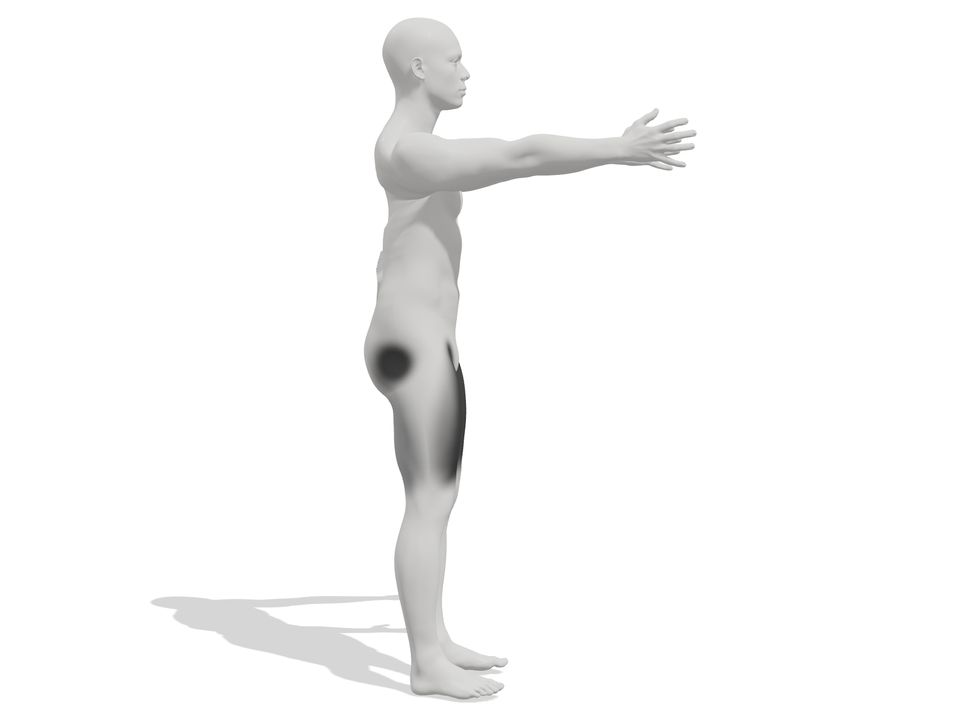
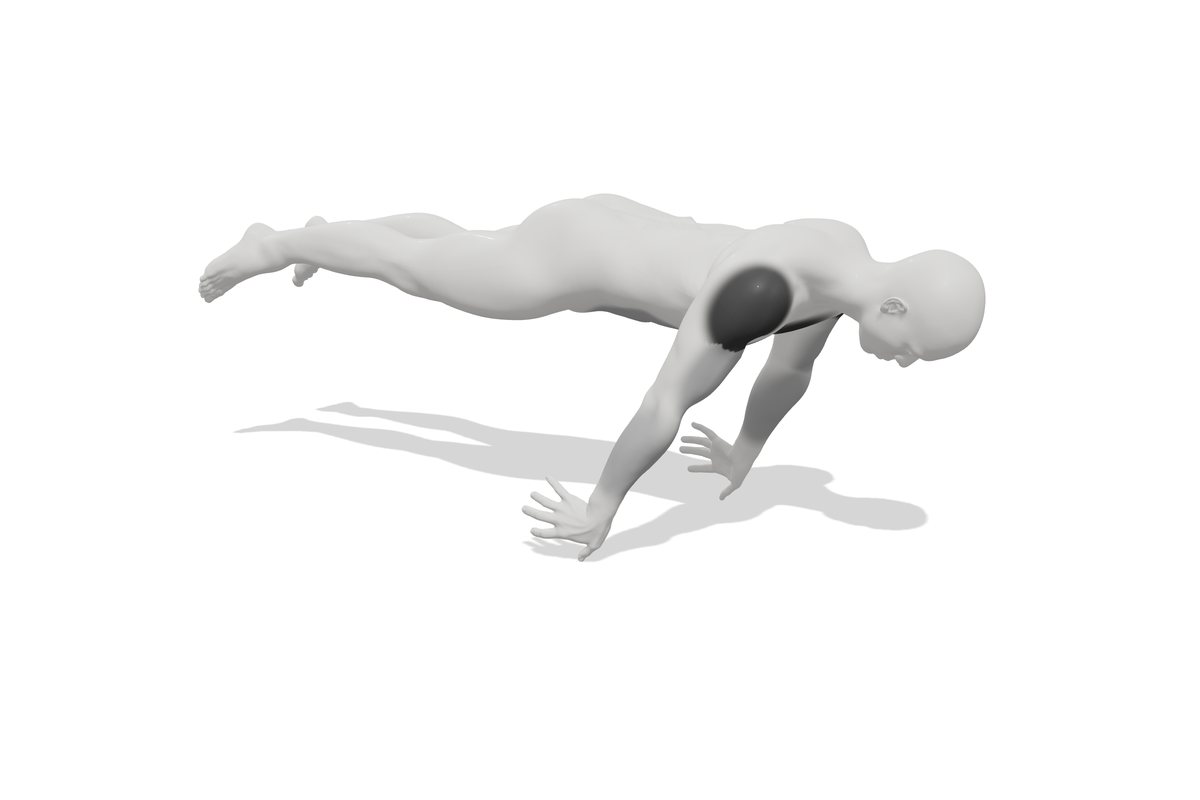
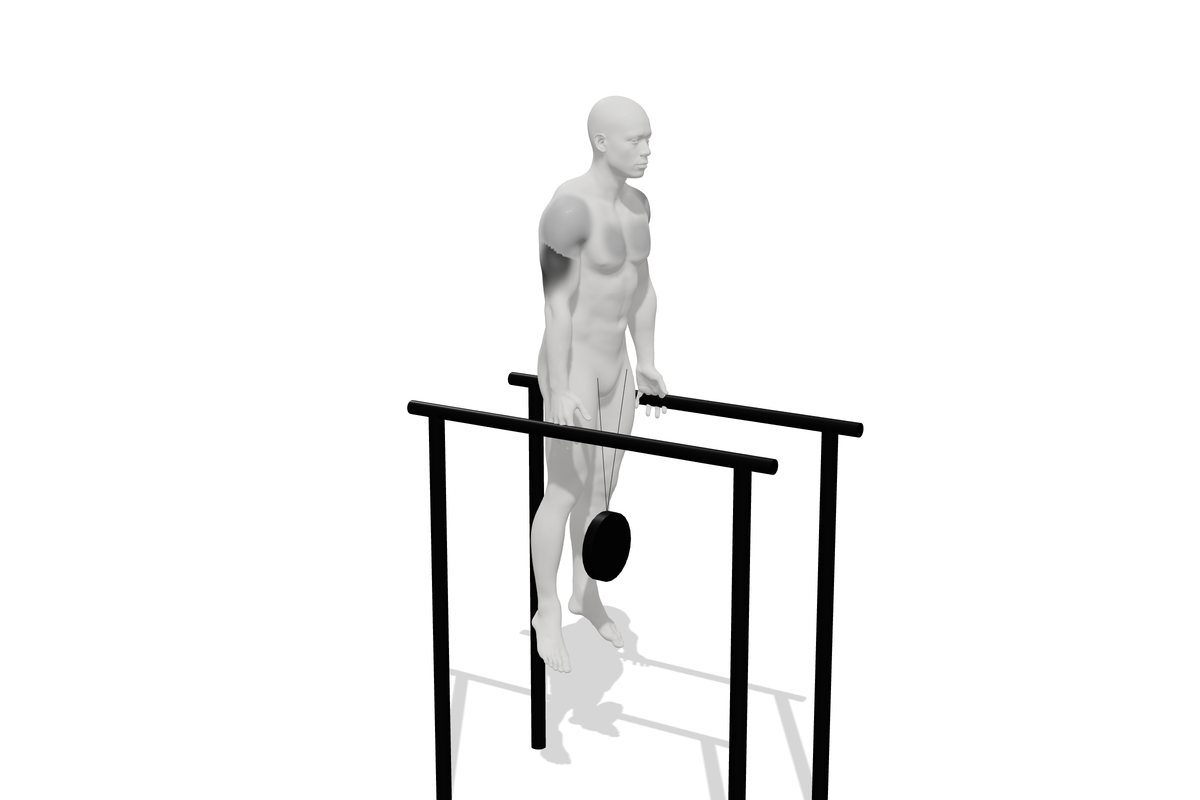
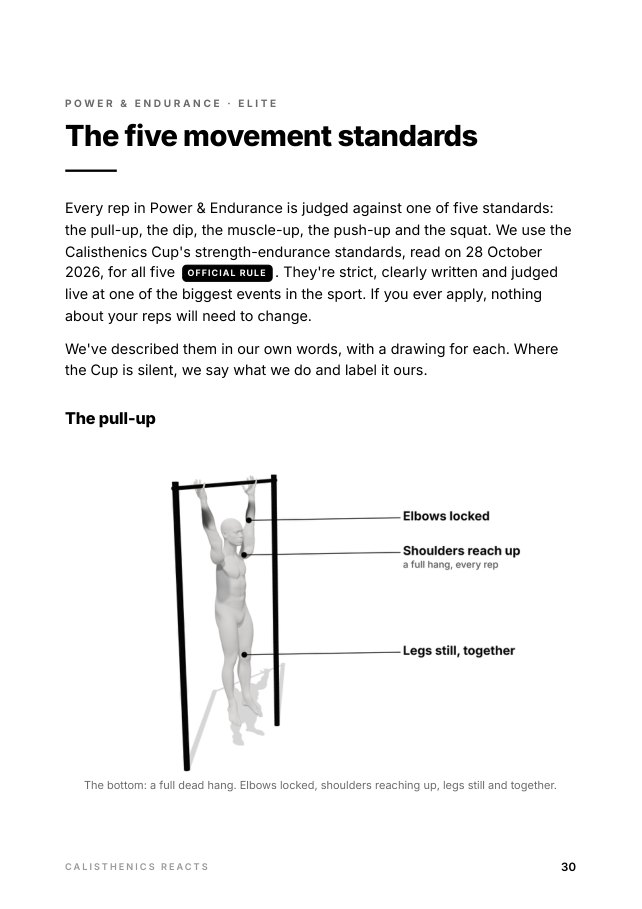
Every movement here is a posed 3D body, start to finish. Each frame is checked against normal joint ranges and the bar or floor before it is drawn. Press play, drag through it frame by frame, or switch the view. The body is Blender Studio’s Human Base Meshes (CC0), posed by our own skeleton.
Full repStart · still dead hang
Full repStart · dead hang
Full repStart · locked out
Full repStart · standing tall
The same level for the other goal, the next level when you pass, and the book on training with what you have.
Each guide earns one level. Its entry test is the level below; its exit test is its own.
Looking for the other goal? Freestyle · Elite →
No. Beginner, Intermediate, Advanced and Elite are Calisthenics Reacts levels. No federation uses them and passing one doesn't qualify you for a competition. Where a guide quotes a competition rule, it names the organiser and the year; where a number is ours, it says so.
Anyone thirteen or older. Standards are split by sex where it's fair to split them, and by age wherever load is involved. No youth label needs an adult load, and every release, flip or loaded test for under-eighteens has a supervision gate.
A pull-up bar, parallel bars or a dip station, a floor, a phone to film with. Parallettes help. Power & Endurance from Intermediate up uses a dip belt; Elite uses a weighted vest. Freestyle releases need landing mats and, at first, a coach.
The one above the level you've already passed. Not sure? Start with Beginner: its entry test tells you within an hour. Each guide's entry test is the level below, so you'll find out quickly if you started too low.
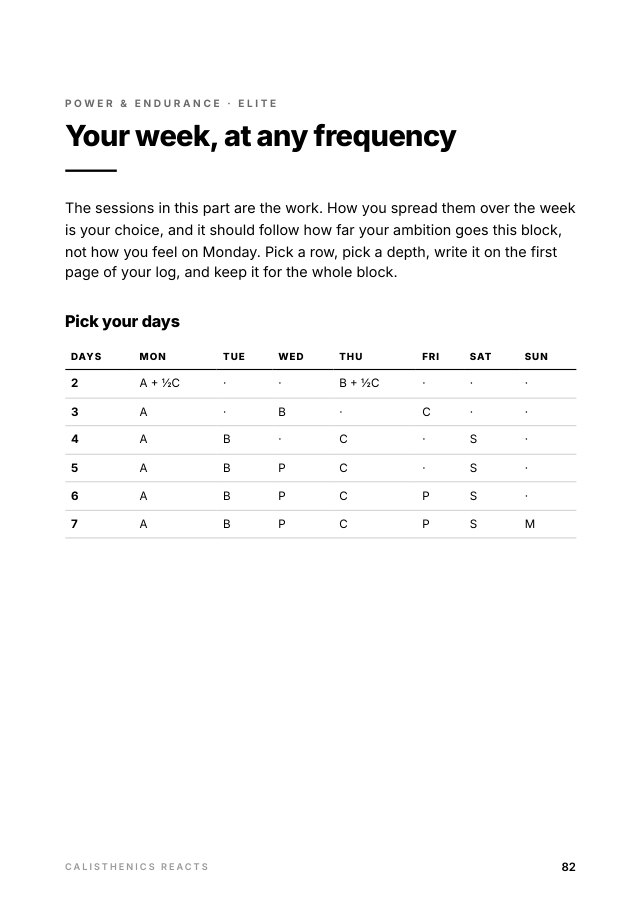
Yes. The guide lays out the same plan for two to seven days a week, at one to three trainings a day (Main, Midday, GTG). Two days stretches the twelve weeks to sixteen; more days add practice and one short session for your weakest area, never a second copy of the week. You can lay it out free in the plan builder before you buy: ecosystemhq.uk/cr-plan.html.
That's the first chapter. Start here gives you eight steps in order, from the entry test (week zero) to your first session, and "If you get lost" points nine common problems to the page that solves them.
Every exercise in the plan has swaps that do the same job, with when to use each one: rows instead of pull-ups, parallettes instead of the floor, a pike hold instead of a wall. The test movement itself stays at least once a week.
Yes, from four days a week. One guide leads the week; the other takes the short session slot, its strength session one week and its power session the next. The plan builder lays it out if you pick both.
No. It teaches; it doesn't diagnose or treat. Every chapter where something can hurt you has a safety gate, and the body part has a pain rule for when to stop and see someone.
Every number comes from one standards file, versioned and dated. When results from real athletes say a number is wrong, we change it, list the change in the guide, and you get the new edition free.
If it isn't what you expected, reply to your receipt. No discounts, ever: the price is the price for everyone.